Breaking Down the August 2026 NDSU Agricultural Trade Monitor: From Broad Tariffs to Targeted Exemptions: Evolving Exposure for Food Imports and Farm Inputs
The August 2026 NDSU Agricultural Trade Monitor examines how U.S. tariff treatment of food and agricultural inputs changed between 2025 and 2026. Tariffs were initially imposed under the International Emergency Economic Powers Act (IEEPA), followed by a temporary surcharge under Section 122 of the Trade Act of 1974 and, subsequently, actions under Sections 301 and 232.
Agricultural exemptions introduced in November 2025 were generally retained as tariff policy moved between statutory frameworks. Later actions expanded the number of exempt tariff lines, introduced country- and agreement-specific provisions, capped tariffs for selected trading partners, and reduced the Section 232 rate on specified agricultural machinery.
The report measures statutory tariff exposure. Except where an exhibit reports total effective rates, the figures are additional duties above the regular most-favored-nation tariff; the analysis does not estimate pass-through to consumer prices or agricultural input costs.
Tariff Policy Moved Across Statutory Frameworks
The initial IEEPA tariffs applied broadly across countries and products. Following the country-specific escalation in August 2025, food and agricultural imports faced an average additional tariff of 13.1%, with especially high rates on unroasted coffee, cocoa beans, beef, bananas, and avocados.
In November 2025, the administration modified the applicable product annexes to exclude several agricultural products. After the Supreme Court held on February 20, 2026, that IEEPA did not authorize the President to impose tariffs, a temporary 10% Section 122 surcharge took effect on February 24 and remained in place through July 24. The current framework replaces Section 122 with actions under Sections 301 and 232.
Exhibit 1: 2025–2026 U.S. Tariff Timeline.

Note: The Brazil Section 301 tariff stacks with the applicable forced labor Section 301 tariff. Goods subject to Section 232 are excluded from the Section 301 tariffs. All tariff actions include product- and/or country-specific exemptions.
Source: NDSU using information from Federal Register notices and USTR.
Agricultural Exemptions Expanded
The share of food and agricultural imports receiving zero additional duty increased from 56.7% under Section 122 to 62.6% under the current Section 301 measures. Product exclusions account for most of the increase in zero-duty coverage, while rates also vary by origin because of USMCA treatment and the capped rates applied to selected economies.
The forced-labor Section 301 proceeding provides the most detailed public record of the exemption process. USTR received more than 1,600 written comments and held a three-day hearing at which more than 100 witnesses testified. The final notice retained most of the proposed exemption list and added 471 products beyond those originally proposed, including planting seed, fertilizer and pesticide inputs, and certain animal products.
Exhibit 3: Monthly Trade-Weighted Additional Tariff Rates on U.S. Imports of Agricultural and Food Products and Agricultural Inputs.

Note: Rates are 2024 import-weighted additional duties above the regular MFN tariff. A rate of zero indicates no additional duty.
Source: NDSU using information from Federal Register notices, USTR, and U.S. Census Bureau.
Food Imports: Broader Exemptions and Shifting Exposure
The average additional tariff on food and agricultural imports increased to 13.1% in August 2025 and declined to approximately 7.0% following the November exclusions. Under the current Section 301 measures, the average additional rate is 4.2%, compared with 4.3% under Section 122.
The largest reductions occurred among products that faced relatively high duties in August 2025. The additional tariff on unroasted coffee declined from 23.5% to zero, and rates on cocoa beans, beef and beef products, bananas, and avocados also declined to zero. During the transition from Section 122 to Section 301, the average additional tariff on dairy products declined from 8.4% to 5.1%, while expanded exclusions reduced the rate on vegetable oils from 5.3% to 3.0%.
Rates increased for several other products, including manufactured tobacco, rice, fresh berries, and poultry, reflecting sourcing from economies in the 12.5% tier and, for some products, the Brazil-specific action. Broader exemption coverage therefore did not reduce tariffs for every agricultural product.
Exhibit 6: Additional Tariff Rates Across Policy Events for Agricultural and Food Products.


Note: The chart includes selected product categories with at least $1 billion in 2024 U.S. imports. Each point is the 2024 import-weighted additional tariff rate in effect at each policy event, measured above the regular MFN tariff. End labels report the additional tariff rate in effect as of August 19, 2026.
Source: NDSU using data from White House, USTR, and U.S. Census Bureau.
Farm Inputs: Tariff Exposure Diverged
Changes in tariff exposure differ substantially across agricultural input categories. Seeds and fertilizers experienced the largest rate reductions, while machinery experienced an overall increase. The additional tariff on seeds declined from 6.4% under Section 122 to 0.2% under the current measures. Current additional rates are zero for nitrogen, potash, and mixed or organic fertilizers and 0.9% for phosphate fertilizer.
Treatment of agricultural chemicals depends on end use. Some tariff lines receive an exclusion only when imported for pharmaceutical use, although the same classifications may also include chemicals used in pesticide production. The affected codes accounted for 40.5% of agricultural chemical imports in 2024. If pesticide uses qualify, the average additional tariff on herbicides remains near 2.9%; if they do not, it rises to approximately 10.5%.
Specified agricultural machinery became subject to Section 232 as a derivative of covered metal products. A June 2026 proclamation reduced the tariff on specified agricultural machinery from 25% to 15% through December 31, 2027. The reduction applies to 19 HS6 product groups representing $10.3 billion, or 77.1%, of U.S. agricultural machinery imports in 2024. Following the adjustment, average additional rates are approximately 15.0% for tractors and self-propelled machinery and 12.1% for other machinery and parts.
Across all agricultural inputs, the current measures add an average of 7.2%, compared with 4.9% under Section 122. Section 232 machinery accounts for approximately 5.4 percentage points of current exposure.
Exhibit 7: Additional Tariff Rates by Agricultural Input Products.
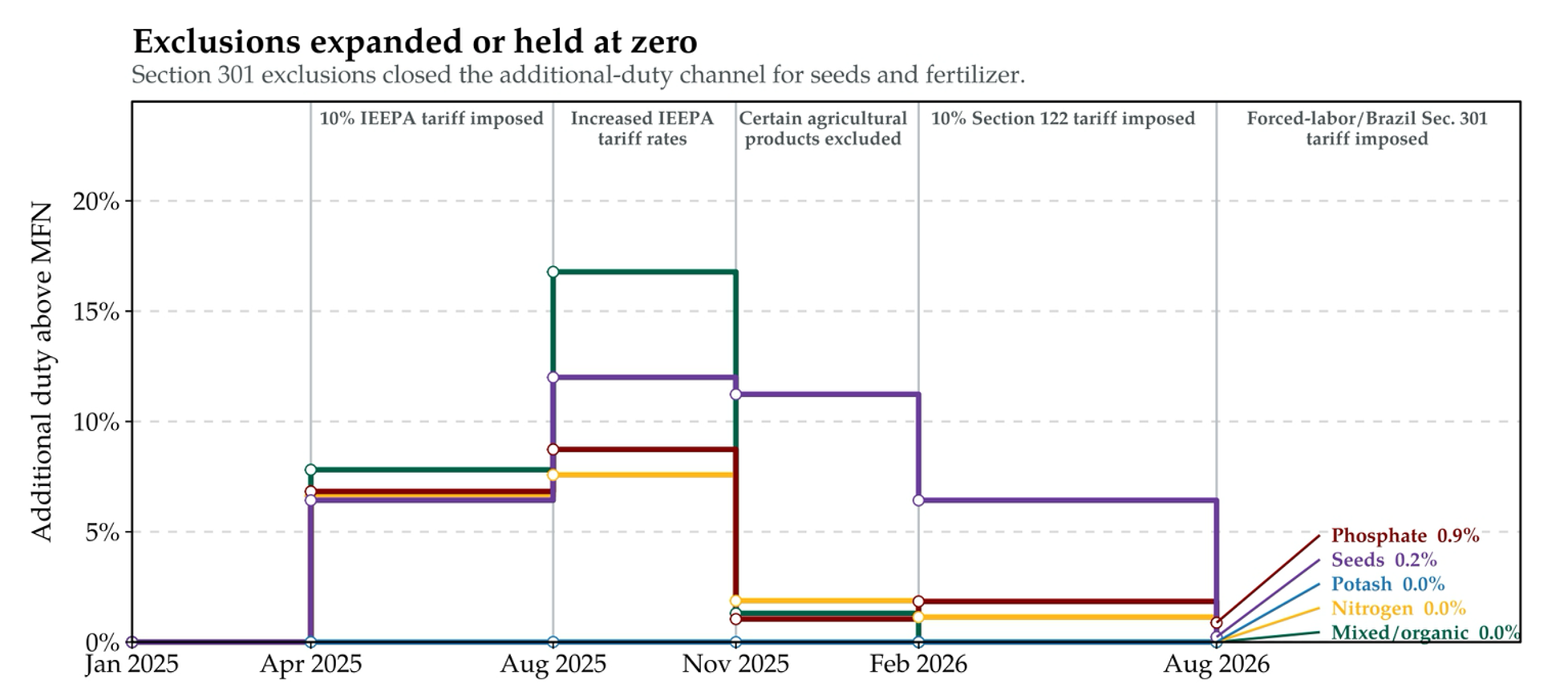

Note: Each point is the 2024 import-weighted additional tariff in effect at each policy event, measured above the regular MFN tariff. The chemicals panel applies the pharmaceutical-use condition as described in the text. End labels report the additional tariff rate in effect as of August 19, 2026.
Source: NDSU using data from White House, USTR, and U.S. Census Bureau.
Pending Actions Could Change the Outlook
The most immediate pending development concerns Canada. Three Section 338 proclamations would apply an additional 50% duty to 554 Canadian tariff lines covering dairy products, alcoholic beverages, honey, live plants and cut flowers, planting seed, processed foods, and selected machinery. A proclamation issued on August 18 suspended the duties before they took effect and set a new effective date of August 22, 2026. Covered lines account for $1.4 billion, or 3.5%, of 2024 U.S. agricultural and food imports from Canada.
A separate Section 301 investigation concerning structural excess capacity and production in manufacturing sectors also remains pending. USTR initiated the investigation in March 2026, covering 16 economies, and held a public hearing in May. No determination or proposed action had been issued as of the report’s August 19 cutoff, and the potential coverage of agricultural products and inputs remained unspecified.
Read the full August 2026 NDSU Agricultural Trade Monitor: From Broad Tariffs to Targeted Exemptions: Evolving Exposure for Food Imports and Farm Inputs
For inquiries, contact:
Shawn Arita – shawn.arita@ndsu.edu
Jiyeon Kim –jiyeon.kim@ndsu.edu
Sandro Steinbach – sandro.steinbach@ndsu.edu